19 October—Last week, Gianni Capozziello, a young Bridgeport policeman on the job five years, was suspended for 20 days without pay for pistol-whipping a teenager in August 2019. It took two years for a short video of the incident to surface. Had the pistol-whipping not been recorded, one wonders whether Capozziello would have been suspended or otherwise penalized at all, especially since the pistol-whipped kid was really guilty of driving a stolen car and possessing drugs.
Evidently Officer Capozziello wasn’t aware that Connecticut Democrats have made adolescent car thieves untouchable by the law. And—wouldn’t you know?—the guilty juvie was later released to his mommy.
On the other hand, did Officer Capozziello really believe the youthful druggie-car thief, who was walking away from him with arms raised, was reaching for a gun? That’s why Gianni used his own pistol as what he called “an emergency impact weapon,” according to his incident report, which doesn’t quite agree with the video.
Should we believe a cop’s statement or a video recording of the actual incident? That’s certainly a tough one.
It happens that Officer Capozziello had been suspended for a whole day last month for using a stun gun on and striking another adolescent back in 2017, this kid having been accused of stealing a volleyball. Not that it appears to matter, but this miscreant’s mother sat on the Bridgeport City Council at the time of the ball bust.
Capozziello, a former Marine, had himself been arrested in 2013 in Norwalk for disorderly conduct and third-degree criminal mischief, but must have had the case dismissed or been granted accelerated rehabilitation, since there are no juicy court records to peruse. Of course, Gianni’s union is rationalizing his excessive use of force and the union president promises to file a grievance on his behalf. Excessive use of union, surely, but that’s what the union is there for.
In these two instances, was Gianni Capozziello too enthusiastic or did he merely panic? If he could learn to temper the excessive use of force he may well have learned in the Marine Corps, he’d possibly be a decent cop.
Will there be any civil litigation for excessive use of force and violation of civil rights with Gianni Capozziello, the City of Bridgeport, and others as defendants? If so, you can bet Gianni will claim qualified immunity. But it’s not unlikely the city has already settled both matters out of court, which may also account for the dilatory suspensions and resultant publicity. Sadly, we may never know how much this excessive use of force was worth.
Tomorrow, qualified immunity gets its well-deserved comeuppance . . .
18 October—Today, the bad news that’s no longer news. In April 2014, a state trooper lost control of his cruiser and struck another vehicle, injuring the driver, but the accident wasn’t followed up with charges or even an investigation. And the police offered no explanation. Information on the accident is still unavailable and there has been no recorded civil or criminal litigation, although there probably was an out-of-court settlement. But the trooper involved is now a detective with the Western District Major Crime Squad, being paid well into six figures in salary and fringes.
Makes you think how good it is to be a cop.
Then, fast-forward seven years to last April, when State Police Sgt. John McDonald, who in November 2019 had been charged with a number of very serious offenses he committed two months earlier, essentially got off scot-free. Having drunkenly run a stop sign in his cruiser, causing a T-bone crash in Southbury, you may recall that McDonald seriously injured a woman and her daughter. But not himself.
But after a dozen continuances, during which he remained on fully paid desk duty, prosecutor Jeffrey Doskos and Judge Kevin Murphy finally decided that McDonald—a colleague of theirs in the employment of the state—didn’t have to serve any time other than 100 hours of community service and minimally attending a drunk-driver program.
Equally disturbing is that McDonald’s offenses would be felonies for civilians. But felony conviction would cost him his job and his pension. So his plea deal reduced his offenses to misdemeanors. And he gets to keep his six-figure job (along with his cruiser and state gasoline) as well as his handsome pension, which doubtless will be enhanced by tons of overtime in his last three years.
And let’s not forget McDonald’s drunken state police buddies who clearly broke DESPP rules at the party at an Oxford brewery. Has anything been done with or about their offenses? Will anything be done?
Makes you think how good it is to be a cop. And qualified immunity didn’t even come into these travesties.
Tomorrow, some encouraging news on qualified immunity . . .
17 October—Although the presumption of innocence is not expressly guaranteed in the Constitution, it’s implicitly supported by the Fifth, Sixth, and Fourteenth Amendments and has been cited in countless decisions of courts from the Supreme Court on down as a fundamental principle of the American system of criminal justice.
But, as we see all too often in criminal trials, the presumption of innocence tends to be ignored in the real world. Or at least abused. It’s the presumption of guilt that prevails. From the complaints of alleged crimes, through investigations, reports, warrants, arrests, hearings, and trials; through police, prosecutors, judges, and juries—the system is implicitly stacked against the defendant.
First off, police, prosecutors, and judges all work for essentially the same employer—some level of government, be it municipal, state, or federal. Even public defenders are paid by the government rather than the defendant. Is that an inherent conflict of interest or what?
Then, it comes up regularly in criminal proceedings that police falsify or otherwise embellish incident reports and warrant applications in order to get judges to issue search and arrest warrants. It’s not uncommon for barracks and police stations to have specialists do the paperwork, which is unlawfully signed by the investigating officers, even though many judges are quick to issue warrants without much prodding.
Judges in trial courts are likely to give prosecutors more leeway than they’d give defense attorneys. And prosecution witnesses, including police, often are considered more reliable, more believable than defense witnesses by juries, even after their testimony is brought into serious doubt. Perjury—testilying, as it’s known informally, especially when committed by police—is not uncommon, to say the least. And police are rarely punished for it.
Similarly, judges are more likely to overlook little oopses and even flagrant violations committed by police than by civilians. The cops are pursuing criminals—make that justice—after all, and nobody’s perfect. And then there are brownie points to consider.
So once the police are on your case, you can be sure that you’re guilty until proven innocent . . .
16 October—Connecticut Democrats have made it easy and want to keep it that way for juvenile delinquents, among others, to get away with crimes, while making police more accountable for their misbehavior. Connecticut Republicans, on the other hand, want to make it harder for juvenile delinquents, among others, to get away with crimes, while making police less accountable for their misbehavior.
The Democrats appear to have more sympathy for criminals than for victims and are quick to point out that criminal offenders—youthful and otherwise—are disproportionately of non-White, minority ethnicity. And that matters because non-White minorities tend to vote Democrat. It must be pointed out that it should be insulting to minorities to be singled out for special treatment of any sort—preferences and affirmative action come to mind. Yeah, right.
Police, on the other hand, tend to vote Republican, so the Democrats generally don’t give a damn about them, even when the police are of non-White ethnicity. But the Democrats are right on the mark when they want police to be held accountable for their misbehavior. It’s only fair, after all. So hit ‘em in the pocket book.
Most cops are perfectly decent people who often put their lives on the line and sometimes have to make split-second decisions. And until 1 July, police in Connecticut could get away with virtually anything that would cost civilians a mint simply by copping qualified immunity.
But, thanks to the police accountability bill that was enacted last year, errant cops will be held personally liable for financial damages when they’ve knowingly violated a person’s rights. And the State Police Administration & Operations Manual even states, however legalistically and obtusely, “Whenever the A&O Manual or any general order is in conflict with the lawful mandate of any federal, state or local law, regulation, ordinance, by-law, or any court ruling which is controlling by law, custom or common practice, such a mandate shall take precedence and shall be controlling, but only to the extent to which it is in conflict with established department policy.”
That simply means cops are supposed to follow the law like everybody else. But don’t they deserve at least a degree of qualified immunity? That’s the Republican view, anyway. Republicans tend to fantasize that police can do no wrong—or very, very little wrong, at any rate; and even if they do violate a right, commit what would be a crime if you or I did it, or take a life, that’s okay if it’s in the line of duty. And even if it’s not in the line of duty, in far too many cases, as we see all too often. Qualified immunity is not and never has been a defense for criminal behavior, anyway.
But police are still protected from purely vexatious litigation, as everyone should be. And there remains a pretty big loophole that clever lawyers for bad cops are bound to use and abuse. It’s that the cops must “knowingly” have violated a person’s rights. We’ve seen time after time that courts tend to let cops get away with all manner of misdeeds because they claimed they didn’t know they were breaking the law. Of course, that’s a crock, because ignorance of the law is no defense for civilians. And aren’t police expected to know the laws they’re supposed to enforce?
Dream on.
Republicans are right on the mark, of course, when they insist that criminals be treated like criminals; and that youthful offenders, as juvenile delinquents are called by the bleeding-heart crowd, be treated like the miserable juvies they are, rather than poor, misunderstood little darlings who must have their asses kissed lest they grow up to be recidivistic adult delinquents.
Just because juvies may come from disadvantaged circumstances doesn’t justify their committing crimes. Look at all the disadvantaged kids, regardless of ethnicity, who have never committed crimes—or at least have never been caught—and have grown up to be successful, law-abiding adults—or at least have never been caught . . .
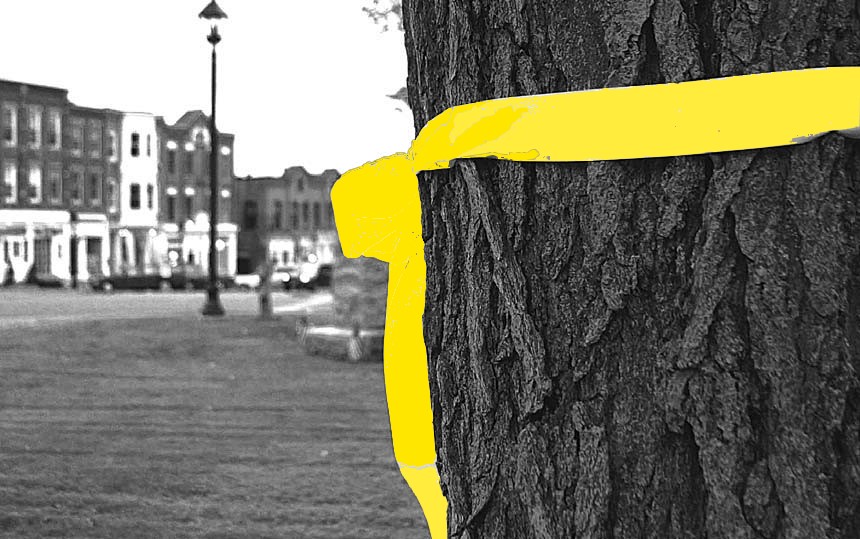
15 October—It was almost exactly nine years ago, after a couple of years of controversy and vandalism, that the Litchfield Borough Board of Warden and Burgesses voted unanimously to allow Val and Leslie Caron’s yellow ribbons to decorate five trees on the green. Make that the Green. (We’re supposed to capitalize Black, after all, so why not Green?) The ribbons, which have suffered some hardships and replacement, have represented—make that honored—serving Army, Navy, Marine, Air Force, and Coast Guard personnel.
But now, the teapot appears to have come to a tempestuous boil again with half the new borough board—a majority of the burgesses present at the 24 September meeting—ordering the yellow ribbons to be removed from the Green by 2 January 2022. Evidently the three new burgesses who voted consider that there’s no longer a reason for the ribbons to be defiling the Green. The lone vote against the removal order was cast by the only veteran burgess.
Does there have to be a reason acceptable to the burgesses? As I wrote in 2012, when Warden Lee Losee, since wisely retired, hinted that he may have been somewhat influenced by the First Amendment, “some benighted people actually think [it] supersedes the borough’s sanctimonious restrictions on free speech.
For the record, in defense of the burgesses, there is a new monument on the Green honoring town residents who have served in the military since 1990. But yellow ribbons, besides honoring convicts coming home (from the song “Tie a Yellow Ribbon Round the Ole Oak Tree”) and military personnel, also was the original symbol for AIDS awareness; is the emblem for bladder cancer, endometriosis, microencephaly, and suicide prevention awareness; and was in the title of a 1949 John Wayne western.
And the yellow ribbons clearly constitute a statement that’s protected by the First Amendment. Therefore, if the Litchfield Board of Warden and Burgesses—the local star chamber—doesn’t see the light, the Carons and other ribbonistas should escalate the burgesses’ unconstitutional ukase. The ACLU and CCLU come immediately to mind . . .
14 October—Today is the 955th anniversary of the Battle of Hastings. You may also see and hear it referred to as the 955-year anniversary by media types who couldn’t tell a pleonasm from a plethora or a paucity.
It was a few miles northwest of Hastings, a big town on the south coast of England, that on 14 October 1066 William the Bastard, Duke of Normandy, led his Norman-French (that’s right, French, but it was a long time ago) army to a monumental victory over the Anglo-Saxons under King Harold Godwinson. Thus commenced the Norman Conquest of England. The battle was actually fought closer to a town now called Battle. For some strange reason.
William the Bastard, as he was known until his PR man came up with the William the Conqueror handle the day after the big battle, was the son of Duke Robert I of Normandy, a.k.a. Robert the Magnificent, a life-long bachelor, and Herleva, who later bore the bastard’s legitimate half-brothers, Odo, Bishop of Bayeux and Earl of Kent, and Robert, Count of Mortain, after she married Herluin de Contville.
Legend has it that Herleva, a commoner, attracted young Duke Robert by showing her leg well above the thigh. Rob couldn’t marry a commoner, of course, but since he always loved or lusted after Herleva, he fixed up his favorite wench with his best bud, Herluin. Even though no historians appear to have written about it, it’s entirely possible—and in the circumstance not unlikely—that Odo and Robert are actually Robert the Magnificent’s sons rather than Herluin’s. Think about it. But we won’t indulge in speculation about what made Robert Magnificent.
On the subject of legends, the one about King Harold being killed by an arrow in the eye may not be totally accurate. The sources are all Norman, of course (since the victors write and weave and sometimes embroider the history), including the Bayeux Tapestry, which was commissioned by the aforementioned Bishop Odo, who fought in his half-brother’s (or brother’s) army, for his cathedral, not long after the Battle of Hastings.
The tapestry shows a soldier with an arrow near his eye, but the soldier doesn’t appear to be wounded because he’s standing up. Harold, on the other hand, is probably the wounded soldier holding a battle axe next to the guy with the arrow. The caption is “HIC HAROLD REX INTERFECTUS EST,” meaning “King Harold was killed.”
We do know that after the battle Harold was butchered by the Normans, in a typically French way, having had his head cut off “below the protection of his helm,” his “entrails liquefied,” and his thigh cut off and carried some distance away.
And Sir Walter Scott was among the writers who made a mint from the sometimes unfriendly relations of Normans and Saxons that followed the Battle of Hastings. But Norman vs. Saxon conflict is largely nothing more than the stuff of good fiction . . .
13 October—Certainly, 44th District Republican State Representative Anne Dauphinais of Killingly (which, for those many Litchfield County people who may not know anything about the far side of the Connecticut River, relaxes in the state’s aptly named Quiet Corner, smack on the Rhode Island border) may have gone a little too far a couple of days ago in comparing Gov. Ned Lamont to Adolf Hitler just because of Lamont’s vaccine mandate for state employees, which the outspoken representative likened to concentration camps.
I’ve called our beloved gubernatorial autocrat “King Ned,” after all, and noted, in The present and future king, that “not since the United States declared independence from Great Britain and King George III has our country experienced a ruler on the throne as long as King Ned Lamont, Connecticut’s former governor.” And, as everybody knows, I never go too far. Well, hardly ever. Read on.
While Rep. Dauphinais might well consider tempering her remarks, she nevertheless deserves some credit for refusing to apologize. Not only does she quite obviously have the courage to stick to her guns in the face of adversity, but it’s entirely possible that even vaccinated people can carry and pass along the dreaded novel coronavirus; it’s not unlikely that the various tests for the virus may not be all that accurate, either positively or negatively; and the effectiveness of the masks worn by most people is more anecdotal than statistical. So what?
So Good King Ned is threatening to fire and actually is firing recalcitrant state employees (but only probationers so far, newbies who don’t yet have the unions behind them) first and foremost as a show of his absolute power because that’s what kings and dictators do. Henry VIII did it. Hitler did it. Ned’s doing it. On the other hand, wouldn’t it be nice if His Majesty exercised his virtually unlimited imperial power in ways to benefit Connecticut’s hard-pressed taxpayers rather than the unions to whom he kowtows in spite of everything he keeps telling us?
In further defense of Rep. Dauphinais, Adolf Hitler—although an undeniably horrible person by any stretch of the imagination—unlike Donald Trump, wasn’t all bad. He liked dogs and often slept with Blondi, the German Shepherd bitch Martin Bormann (Hitler’s private secretary) had given him. We won’t speculate on what Wolf (which is what very close friends called Hitler) and Blondi did in bed.
And Wolf could be quite considerate. It seems that his girlfriend (and wife for her 40 last hours), Eva Braun, didn’t much like Blondi. Or sleeping with Wolf, apparently. (Maybe they both shed.) So he was nice enough to give her two Scotties, Negus and Katuschka (nicknamed Stasi, for some reason, which name the post-war communist East German security service, Staatssicherheitsdienst, adopted as its acronym). Eva loved her Scotties, which is quite understandable. And Scotties don’t shed.
Sad to say, Hitler, having lost trust in Heinrich Himmler, tested one of the cyanide suicide capsules the SS boss had given him on Blondi, who had recently whelped. It worked. Not that it would have made any difference, because Wolf had intended to have her killed anyway, just to keep her out of the hands of scumbag Joe Stalin’s Soviets. It’s reported that Wolf was inconsolable upon Blondi’s death. We know the feeling.
It was reported in 2005 by a nurse who had been present in the Führerbunker at the bitter end that Blondi’s death affected the people in the bunker more than Eva Braun Hitler’s suicide, which Eva probably wasn’t too happy about either. Had she not been suicided [sic], it’s not unlikely Eva would have received minimal, if any, punishment at the Nuremberg trials.
And the day after the Führerbunker suicides, innocent little Negus and Stasi were shot by Hitler’s dog handler, along with some other dogs, including his own dachshund. All the dogs certainly deserved better . . .
12 October—As if the prospect of our beloved (and entirely trustworthy, of course) federal government knowing the smallest details about our financial life weren’t bad enough, consider that you don’t need to have opened an account with Facebook or even visited it for the antisocial juggernaut network to know all about you.
And, probably to a somewhat less disgusting but equally intrusive extent, the same goes for virtually all the businesses we visit online, even if we just look but not buy. What do algorithms know about curiosity? That’s why even the good online businesses bug us incessantly about things we might have looked up on their websites. Are they trying to wear us down? Of course.
Then there are the rap-sheets credit-rating agencies keep on us that we’ve accepted for decades—with unenthusiastic resignation, to be sure—because we realize that their intrusive surveillance is necessary for our own convenience. And we grudgingly accept that we can’t do a bloody thing to correct any of the misinformation that they’re all so quick to sell.
You don’t want to know what your tattletale smartphone tells everybody, including the government, about you, from where you are to what you’re doing to how much you’re spending on what. Not to mention if you’ve been spending too much time around somebody harboring the novel coronavirus. And who knows what else? And you needn’t have installed intrusive apps and authorized whatever it may be for your privacy to be invaded.
On the subject of covert federal government surveillance, how many of us have bothered to exercise our right guaranteed under the Freedom of Information Act (5 U.S.C. § 552) and the Privacy Act (5 U.S.C. § 552a) to inspect the dossiers the FBI and other government agencies have on us? There’s likely a hell of a lot of misinformation gathered and compiled, for whatever reasons, by government operatives. Just like the credit-rating agencies, only worse.
Keep in mind that the FBI, in addition to legitimate law-enforcement activity, has from its earliest days unashamedly, usually unlawfully, spied on people who have simply exercised their right to speak out against government policies, Constitution be damned. And it’s nonpartisan.
And the NSA—which will in all likelihood deny any request to inspect its files for what the agency will insist, usually without justification, are national security reasons—is authorized to do virtually anything to monitor, collect, and process information to protect the good guys. That includes keeping dossiers on any people who may have had even casual intercourse—make that communication or contact—with known or suspected bad guys. Better safe than sorry, after all.
What can you do about all this surveillance anywhere and everywhere? Grin and bear it. And, of course, keep calm and carry on . . .
11 October—If the ultra-left’s plan to require reporting of all financial transactions and activity over $600 (or any amount like that) ever comes to pass, the next step will be for the Bureau of Engraving and Printing’s paper supplier to embed microchips in all paper money so that the IRS, FBI, CIA, NSA, and anybody else with a suitable scanner will be able to follow the progress even of one-dollar bills.
That’s not as crazy as it may seem at first glance. Something like 90 percent of dollar bills in circulation have been shown to contain cocaine residue, so microchips in the bills would allow authorities to trace the progress of the coke dealers and users; and—more important—collect big fines to pay for the Democrats’ $3.5 trillion giveaway.
Embedding microchips in paper money certainly isn’t a problem. Crane and Co.—the paper supplier to the Bureau of Engraving and Printing since 1879, as well as to Tiffany’s—has been putting anti-counterfeiting devices in bigger bills for some time. And the printing itself involves holograms and other clever, sneaky devices. So why not microchips?
And let us not forget that microchips can be made so small that they can be injected through minuscule 25-gauge hypodermic needles we don’t even feel when we get our COVID-19 shots. Ain’t technology great? And can’t you come up with a better reason to not get a COVID jab?
10 October—Is anybody surprised that the ruling party in Washington wants to further invade our privacy by making financial institutions report to the dreaded Internal Revenue Service any transactions or activity over $600? Not just cash, mind you, like the pain-in-the-ass $10,000 form 8300 reporting requirement from the Nixon era.
That’s the plan of the ultra-left Democrat cohort—the wannabe socialist sociopaths who call themselves progressives—to generate the wherewithal to finance their unrealistic, unworkable, ungodly $3.5 trillion suck-up to buy themselves votes by essentially preempting tax evaders before they can do what most people do and will still find a way to do.
That’s the widest-ranging spending plan of all time that President Joe Biden insists will cost absolutely nothing. Not that it matters, but nobody takes Joe seriously anyway, especially his own Democrats. When you think about it, has anyone ever taken him seriously?
Wasn’t former senator and vice president Joe Biden allowed to get the Democrat nomination to run against Donald Trump only because he was the least obnoxious, belligerent, and controversial—as well as the most ineffectual—of the contenders last year? And after 44 years on the public payroll as a party loyalist and uncontroversial seat holder who made a name for himself by accomplishing absolutely nothing, wasn’t it about time he got his reward?
Joe’s a good guy. And he does what he’s told.
What else is there to say about Joe Biden? Oh yeah. At least he’s not Donald Trump. That’s the only reason he got elected . . .
9 October—Hobbling home from the post office the other day, just past the Noyes Memorial Building (a.k.a. the Litchfield Historical Society) on East Street, I was rather taken aback by a couple on the sidewalk in flagrante delicto. Indulging in sexual intercourse, brazenly copulating in public. They obviously didn’t care who saw them humping, screwing, getting it on, schtupping. And, of course, fucking. Our friends across the pond call it rumpy-pumpy. It was East Street, so what the hell, you say. But was the audacious couple making love?
That got me thinking about the word “love.” What does making love really mean? Does love at first sight actually have anything to do with love? Or is love merely a euphemism?
Consider the concept of love. But first let’s get the tennis expression out of the way. In that sport’s scoring, love means nil, nought, bupkes. Or zero. A zero is an oval. Goose egg. Or just plain egg-shaped. The French for “the egg” is “l’oeuf.” Brits mispronounce all languages (including American English), so they made l’oeuf into love. Easy as that.
Leaving tennis, then, love, simply defined, is a state of feeling that manifests itself in solicitude, delight, affection, and other nice, desirable things. So can a person actually love a perfect stranger? Or is love at first sight simply and more accurately lust at first sight? Isn’t the spark between two people really lust rather than love?
If you’re lucky, physical attraction—lust—will lead to love. Familiarity certainly can breed contempt, but it can also breed love.
And the very expression “making love” is totally ridiculous, even ludicrous, a brilliant euphemism if ever there was one. The act of copulation is purely physical and neurological, after all. It feels good. That’s why all animals strive to copulate; they don’t consider that they’re procreating in order to propagate their species and they probably don’t know anything about love. If actual love is involved (in whatever species), it’s only because anything and everything feels better when you do it with someone you love. But it’s an indisputable fact that in the real world love isn’t a requirement for sexual intercourse among Homines sapientes, even religious ones.
And I’m not going to quote Cole Porter’s “Let’s Fall in Love.”
Incidentally, the couple copulating on the East Street sidewalk were bumblebees. Evidently they didn’t want to do their rumpy-pumpy in front of their friends in the hive . . .
