2 December—It’s hard to believe, but until 1965 it was illegal to buy and use contraceptives in Connecticut. The Comstock Laws of 1873 were a set of federal acts of Congress fortified by related legislation in the various states that criminalized the use of the mails to send obscenity, contraceptives, abortifacients, sex toys, personal letters with any sexual content or information, or any information regarding those items. Really!
Connecticut’s Comstock law specifically prohibited the use of “any drug, medicinal article, or instrument for the purpose of preventing conception.” Absolutely ridiculous. And by the fifties only Connecticut and Massachusetts had the outlandish legislation on the books, even though the laws were seldom enforced.
But in 1965, in Griswold v. Connecticut, the United States Supreme Court ruled that the Constitution protects the liberty of married couples to buy and use contraceptives without government restriction. Griswold was Estelle Griswold, head of Planned Parenthood of Connecticut.
SCOTUS held, with two justices dissenting, that the statute was unconstitutional, having “the clear effect of [denying] disadvantaged citizens . . . access to medical assistance and up-to-date information in respect to proper methods of birth control.” The dissenters were former KKK member and FDR appointee Hugo Black, who found the law “offensive” but constitutional; and Potter Stewart, moderate Republican (and Hotchkiss and Yale alumnus) appointed by Ike, who opined that the law was “uncommonly silly” but constitutionally valid.
While the Constitution doesn’t explicitly mention a right to privacy, William O. Douglas, writing for the majority, asked, “Would we allow the police to search the sacred precincts of marital bedrooms for telltale signs of the use of contraceptives? The very idea is repulsive to the notions of privacy surrounding the marriage relationship.” Arthur Goldberg concurred, citing the Ninth Amendment—“The enumeration in the Constitution, of certain rights, shall not be construed to deny or disparage others retained by the people.”
And Byron White and John Marshall Harlan II concurred, citing the due process clause of the Fourteenth Amendment—“No state shall make or enforce any law which shall abridge the privileges or immunities of citizens of the United States; nor shall any state deprive any person of life, liberty, or property, without due process of law; nor deny to any person within its jurisdiction the equal protection of the laws.”
Before Griswold, SCOTUS hadn’t done much with the right to privacy, but that decision essentially paved the way to Roe v. Wade, in which the Supremes ruled, with Byron White and William Rehnquist dissenting, that a woman’s right to privacy extended to the fetus or unborn child she was carrying . . .
1 December—Remember Mike Pence? He was Scumbag of the United States Donald Trump’s complaisant vice president, defending the chief without fail, faithful to a fault. Until as President of the Senate he manifested some scrotal content when it counted by refusing to cooperate with Trump’s incredibly desperate—and, as usual, self-centered—plot to subvert the democratic process on 6 January.
Trump naturally denounced Pence’s treachery (i.e., refusal to do the wrong thing) and Trump’s enthusiastic goons shouted “Hang Mike Pence!” as they overwhelmed the Capitol. Anybody’s guess whether those morons actually would have done it had they been able, but I wouldn’t put it past them. And of course Trump defended his morons: “Well, the people were very angry.”
Mike Pence has been mooted as a possible—perhaps even probable—Republican presidential candidate in 2024. Instead of Trump or Trump Jr., for instance. Nice clean-cut Christian guy, blah blah blah. And not Kamala Harris.
But I suspect nice Mike scotched his chance to achieve the Oval Office when he told the National Press Club last night that the Supreme Court’s decision on Roe v Wade, protecting a woman’s right to have an abortion, was “misguided” and “inflicted a tragedy not only on our nation, but on humanity, that is hard to fathom,” unfairly harming millions of unborn children while triggering a ripple effect of consequences across the country.
“We are asking the Court, in no uncertain terms, to make history,” Pence said. “We are asking the Supreme Court of the United States to overturn Roe v. Wade and restore the sanctity of human life to the center of American law.”
No surprise there, as Pence, who describes himself as a “born-again, evangelical Catholic,” has steadfastly defended the right to fetal life from the get-go. While I can’t support his stand, I must nevertheless give him credit for not only defending, but enthusiastically pressing his beliefs. And he may very well get his wish, or part of it.
The point, however, is that regardless of how the Supremes rule, a majority of American voters favor abortion rights to a greater or lesser extent and thus may well be inclined to punish Mike Pence for his staunch anti-abortion stand. The GOP nomination is one thing, the national election is quite another . . .
30 November—On the subject of the Litchfield Chabad klavern’s relationship with the Borough, creditors, and me going downhill all the way after Chanukah 1996, I learned only yesterday that the ceremonial lighting of this year’s Chanukah menorah in front of the Chabad-Methodist church on West Street was held at the very same time as Litchfield Park and Rec’s ceremonial lighting of the Christmas tree on the Green. Within earshot of one another.
The menorah is supposed to be lit at sunset and I doubt the Christmas tree lighting was planned to conflict with it. So it was a coincidence. But why did the Chabad people insist on playing their music so goddamn loud that it drowned out the more sedate Christmas tree ceremony? God forbid the Chabadniks should have shown any consideration for the gentiles.
Reminds me of when Goldie the bus had been parked in front of the former Wilderness Shop before becoming a mouldering rust-bucket in the driveway of the decaying never-to-be “Future home of Chabad-Lubavitch community center”:

29 November—Today, 25 Kislev 5782 on the Jewish calendar (euphemistically called the Hebrew calendar), is the first day of Chanukah, also spelled Hanukkah, among the many transliterations of Hebrew to English. It celebrates the rededication of the second Jewish (or Hebrew) temple in Jerusalem and lasts through 6 December. And it brings to mind the Chanukah of 1996, when there actually was a menorah on the Green. It wasn’t easy, but it was fun. Okay, it was easy.
In 1996, Joey Eisenbach and his Chabad Lubavitch of Litchfield County Inc. had only a mail drop in Litchfield, but no physical presence. (The good old days, to be sure.) But Joey approached me with the possibility of having a menorah on the Green. Great idea. There’s a Christmas tree, after all, so why not a menorah? As a borough resident, I’d be delighted to sponsor it. There shouldn’t be any problem, even without invoking the First Amendment.
Talk about yellow ribbons. The borough warden at the time, who also happened to chair the Hysteric District Commission, was dead set against a menorah on the Green. He came up with any number of desperately lame reasons it shouldn’t be done. One of his memorable rationales, as he explained in The Litchfield Enquirer of blessed memory, was that the veterans of several wars whose names were inscribed in various tablets on the Green would roll over in their graves if a menorah were to be erected.
Well, Peter Gay, a Litchfield native and still one of our finest citizens, retorted in the very next Enquirer that as a Vietnam veteran whose name was inscribed on the Green, he would be proud to have a menorah there and couldn’t wait to see it.
Not that anything would or could have kept the menorah off the Green anyway.
So a standard stylized menorah was erected on the East Green, a bigger version of the one currently in front of the Chabad-Methodist church on West Street, but smaller than the one on the New Haven Green. The candles on Litchfield’s menorah were represented by oil lanterns. (Oil lanterns, it happens, were closer than candles to the alleged minor miracle commemorated by Chanukah.)
It was the first snow of the season on Chanukah Eve of 1996. My son and I had barely cleared the snow from our driveway when Joey Eisenbach drove up to invite me to light the so-called shamash (sexton or servant) lantern and then the first of the eight nightly lanterns from it. Quite an honor. So even though I’ve been anti-religious since I started to think for myself, what the hell?
An elite group of celebrants, who probably were Jewish, braved mildly driving snow to watch me pretend to be Jewish. I did it well and even recited the appropriate blessings without prompting. And I must admit it felt pretty good. Why can’t I remember how I was able to light one lantern from another?
But after Chanukah 1996 it’s been downhill all the way . . .

27 November—The latest variant of the novel coronavirus affectionately known as COVID-19 has been labeled by the World Health Organization (WHO? you may ask) as the Omicron variant. Last we knew, the Delta variant was making headlines. And still is. So how come the jump in Greek letters from Delta to Omicron?
First, just to refresh your memory, here’s the Greek alphabet, each letter written out in English, followed by Greek upper case and lower case letters. Don’t worry about pronunciation or alternate letter forms:
Alpha Α α
Beta Β β
Gamma Γ γ
Delta Δ δ
Epsilon Ε ε
Zeta Ζ ζ
Eta Η η
Theta Θ θ
Iota Ι ι
Kappa Κ κ
Lambda Λ λ
Mu Μ μ
Nu Ν ν
Xi Ξ ξ
Omicron Ο ο
Pi Π π
Rho Ρ ρ
Sigma Σ σ
Tau Τ τ
Upsilon Υ υ
Phi Φ φ
Chi Χ χ
Psi Ψ ψ
Omega Ω ω
With the Greek alphabet out of the way, what happened to all the variants before we even got to Delta? Well, first, WHO assigns Greek letters to the variants to make them easier for laymen to understand. So WHO says, anyway.
Then the Centers for Disease Control and Prevention tell us—but the CDC tells us—that there are four classes of SARS-CoV-2 variants, essentially telling us how much we should worry: Variant Being Monitored (VBM); Variant of Interest (VOI); Variant of Concern (VOC); and Variant of High Consequence (VOHC).
Among those variants are many of the Greek letters. WHO chooses not to use Nu and Xi, Nu because it could be mistaken for New as in Novel, Xi because it’s the Chinese dictator’s name, and he certainly can’t be associated with the Chinese virus. No politics involved in viral nomenclature, obviously.
As things stand now, Alpha, Beta, Gamma, Epsilon, Eta, Iota, Kappa, Mu, and Zeta are VBMs; Theta and Lambda are VOIs (but not according to CDC); Delta is a VOC; and no VOHCs have been identified—in the United States, anyway. Yet. Evidently, we’re not supposed to know about variants that are simply being monitored until they become of concern. Or worse.
So what about Omicron? WHO said it’s a VOC? WHO did. And that drove financial markets down all over the world. Great for short sellers. So it seems that only letters at the end of the alphabet are waiting for coronavirus assignment. And since viruses continuously evolve, we may be seeing an Omega variant before too long. Something else to look forward to . . .
26 November—The front-page headline over the fold in today’s Republican-American jubilantly proclaims, “Trooper’s downfall complete/Kept job after drunken-driving crash; lost it amid computer probe.” It was an utter delight to read Brigitte Ruthman’s story about John McDonald, the now-former state police sergeant of whom I’ve written on a number of occasions.
The subject of two internal affairs investigations at the time—and perhaps still ongoing—McDonald resigned effective 4 November. Little else is revealed in the story other than that McDonald had falsely accused a Sgt. Adam Rosenberg of violating the law and department policy for doing what McDonald had evidently done himself. The state website tells us that Adam is now Lt. Rosenberg. No relation, but mazel tov.
But there’s nothing on the state website about anyone named John McDonald regarding payroll or pensions. Curious? There’s a Ronald McDonald who wisely retired out of state, and a John McKenna who’s retired in-state. But no John McDonald.
I like to think that since McDonald evidently violated at least one of the terms of his sweetheart plea agreement—to not commit any crimes, which isn’t too much to ask, especially of a cop—he rendered himself ineligible for the lucrative pension he’d otherwise be entitled to. But I shouldn’t count on it. So it remains to be seen if the disgraced trooper’s downfall actually is complete . . .
25 November—No better time than Thanksgiving Day to suggest several great reasons for you to not eat turkey. Ever.
Over 220 million turkeys are slaughtered each year, 45 million of them for Thanksgiving meals. Modern domestic turkeys, which are twice the size of their ancestors of less than a century ago, are selectively bred to maximize meat production and are forced to grow so big that they can’t do normal things like walk and breathe properly. And the hens are artificially inseminated. Forcibly, of course. Is that a life for any sentient being?
Like humans, turkeys form strong bonds with other turkeys, animals, and people. And, like our pets, turkeys enjoy playing and are curious. And lovable. But the ones bred for you to eat never get to experience things like spreading their wings, running around, or being treated kindly.
Turkeys are naturally affectionate and smart. Like any animals. Wild turkeys, like the ones I photographed in my pasture, love to forage, build nests, and roam around their natural territories. Domestic turkeys bred for meat, on the other hand, are forced to live in cramped conditions inside dark sheds with nowhere to roam, forage, or build nests.


Aggressive behavior is common in those high-stress conditions. But instead of raising turkeys in less crowded conditions, greedy factory farmers reduce the risk of turkey-inflicted injury by searing off their beaks, cutting off their toes, and slicing off their snoods without anesthetics. Mutilating birds so they can’t mutilate each other? I’d like to mutilate the factory farmers.
Besides being inhumane, factory farms are filthy and unhealthy. Infections are common among the turkeys, like the severe skin infection pictured here, which probably started when the victim was pecked by another stressed turkey in the cramped quarters.
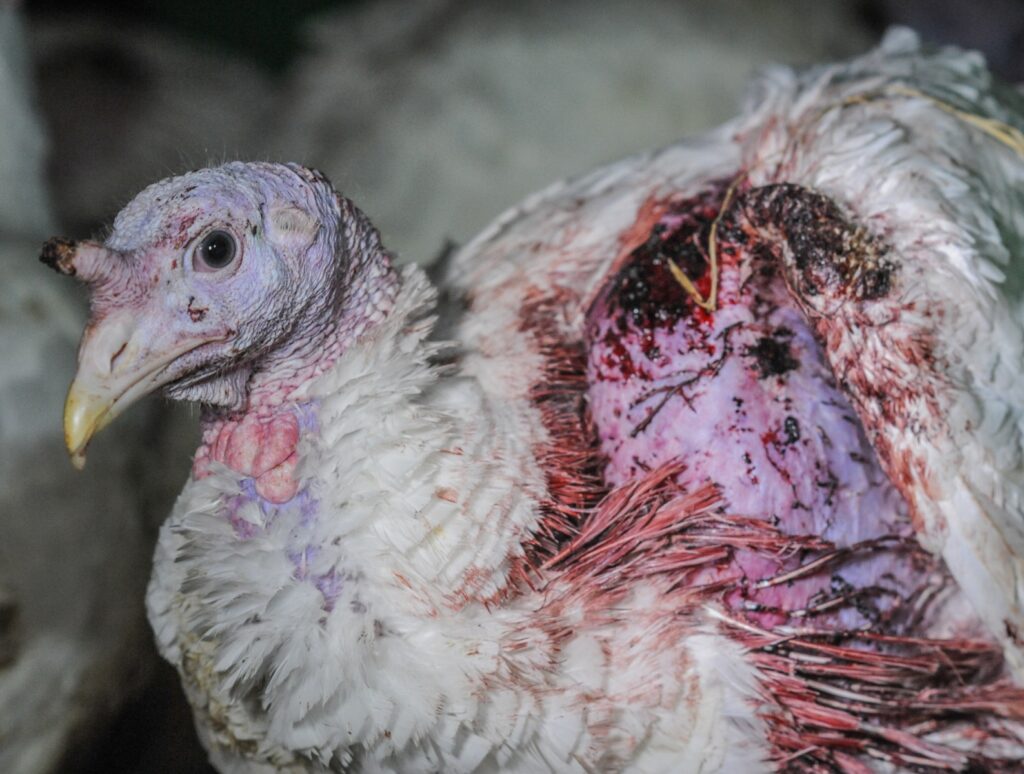
Sanitation in the factory farms? Are you kidding? I won’t even go there. Suffice to say, a couple of years ago Jennie-O and Butterball had major recalls because of salmonella outbreaks. Jennie-O’s salmonella resulted in human fatality.
Having been subjected to incredible physical and mental suffering, as well as thoroughly barbaric, inhumane treatment—make that unmitigated torture—you’d think modern domestic turkeys would be lucky to be slaughtered when they’re only about five months old. But even the slaughtering is exceptionally cruel.
Even the less inhumane methods of murdering the poor turkeys are disgusting. Here’s a picture of a killing cone, which keeps the victims from squirming while their throats are being slit.

Electrical stunning is supposed to render the victim turkeys unconscious before they meet their maker. But the stunning actually causes epileptic-like fits. Among the so-called humane methods of slaughter are neck cutting, dislocation, gas killing, and concussion stunning.
The most common form of stunning in this country is electric immobilization. The live turkeys are shackled by their ankles, which usually breaks their bones. Then they’re run along a conveyor belt through electrically charged water, which is supposed to render the poor captive birds unconscious. But often the electrical charge is too low and the victims are fully conscious as they get their throats slit by a rotating blade.
And if the blade misses, the living turkeys are dumped into scalding water anyway to loosen their feathers. Talk about being boiled alive.
The Humane Slaughter Act of 1978 requires what’s supposed to be humane handling of animals before and during slaughter. But it doesn’t apply to turkeys or chickens. Poultry birds and factory-farmed animals have virtually no legal protections.
The people who slaughter the animals suffer all manner of injuries, including burns, fractures, and amputations. Great. No problem there, for me at least. Unlike their victims, they certainly deserve to suffer. They tend to be inhumane brutal sadists who delight in inflicting pain on their innocent, helpless victims any way they can.
Keep in mind that humane slaughter simply does not exist. For any animal. And there are very tasty plant-based and other non-slaughter meat alternatives that are also healthier than cruelly manufactured animal-based meats.
And don’t forget that turkey meat wasn’t even served at the first alleged Thanksgiving dinner . . .

24 November—The ambulance chasers did it again. Yesterday, a federal jury in Ohio determined that CVS, Walgreens, and Walmart were essentially responsible for the opioid crisis in general that allegedly cost two of the state’s counties (the plaintiffs) big bucks. The deep-pockets chains were found to have recklessly created and maintained a public nuisance by dispensing perfectly legal drugs after the drugs had been prescribed by physicians and other drug-licensed practitioners.
The jury verdict is a major miscarriage of justice—more properly called bullshit—and deserves to be thrown out on appeal. The case should have been summarily thrown out by the trial judge. Or the judge should have directed a verdict for the defendants on at least two grounds.
First, take the public nuisance crap. Please. The concept and practice of public nuisance is broadly defined, vague, and tends to be treated with contempt by rational courts. Gayle Carr’s star chamber in the Borough of Litchfield could claim the Carons’ yellow ribbons are a public nuisance, for instance. And we know what Gayle’s girls and the Borough are full of.
Then there’s the reckless distribution nonsense. A pharmacy may not lawfully dispense prescription drugs without prescriptions. That’s a given. And the plaintiffs didn’t allege otherwise. Nor may a pharmacy refuse to dispense a lawfully prescribed drug without facing the wrath of the prescribing physician and patient, not to mention legal consequences. A pharmacist may well know more about drugs than a prescribing physician, but the physician calls the shots.
It’s also more than likely that the ambulance chasers in Ohio reckoned it was easier to sue and collect from a few big chains than from hundreds, perhaps thousands, of physicians in small practices, not to mention the nonprofit medical facilities that likely prescribed most of the opioids . . .
23 November—Yesterday was what pleonasts call the 58 year anniversary of the assassination of President John F. Kennedy in Dallas. Do you remember what you were doing when you learned that JFK had been shot?
I was in my college’s English faculty office making some Verifax copies of my illustrated notes on John Webster’s delightful revenge tragedy “The Duchess of Malfi” for a seminar on Jacobean drama. Who the hell was John Webster? Don’t worry. But he was the kid in the street in “Shakespeare in Love” who told Shakespeare that when he wrote plays they’d be like “Titus Andronicus,” full of blood and gore.
More to the point, for all my younger readers, what the hell are Verifax copies? Well, back in 1963, the college president’s office had a Xerox, but the department offices, as I recall, had to make do with Verifaxes or Ditto machines.
Kodak Verifax involved a machine with an arched platen, several steps, liquid, peeling, squeegeeing, drying, and quite a bit of patience. It was no fun, to be sure. And Verifax copies tended to fade over time. But Verifax was considerably less messy than the mimeograph and could reproduce pictures, however poorly.
In addition to lots of carbon paper, the English office also had a Ditto machine, of course, since most of its mass duplication and reproduction involved words rather than photographic images. With Ditto—spirit duplication—you typed or scribbled a stencil, which you placed on a drum and spun around as paper was fed through. The Ditto spirit smelled like rubbing alcohol because that’s essentially what it was. Spirit duplication, like Verifax, was considerably less messy than mimeograph.
The last time I saw a mimeograph machine must have been in the early fifties, when I was the PS 174 mimeograph monitor, among other things. Like the Ditto, the mimeograph used stencils on a revolving drum. Unlike the Ditto, the mimeograph used messy black ink. But in those days I was a neatnik and never had a problem with recalcitrant ink, never got it on me or anywhere else it wasn’t supposed to be. And there was always cleaning fluid and Gre-Solvent for ink attacks.
On the other hand, there was my assistant, Michael. This kid’s father was a lawyer with a new Lincoln every year; his mother was a teacher with his father’s Lincoln the following year; and they lived in a fancy modern (better than Bauhaus) house a couple of blocks away. Lovely people, actually. And Michael wore Saks Fifth Avenue shirts and ties and pants. Probably Saks Fifth Avenue underwear too, but I wasn’t that curious.
Michael was a very bright kid. And a friend in spite of it. But a slob to the core, the acme and epitome of irredeemable sloppiness. I expect he didn’t want to be a slob, but he just couldn’t help himself. Unfortunately, he was the only kid who volunteered to be my mimeograph assistant. I’d have given him more credit, but what did I know?
My father had given me an old lab coat of his so I wouldn’t mess up my bargain-basement clothing. But I didn’t need the lab coat, of course, so I let Michael use it. And even with the buttoned-up lab coat and sometimes even a smock over that, Michael managed to go through a shirt, tie, and pants every day he even approached the mimeograph. That was about once a week.
After a couple of months on the job, his mommy asked me to fire Michael. I must have been 11 and had never done anything like that before. Or since. He accepted his fate with great aplomb and we remained friends—and he remained a slob—through junior high school, anyway. He went on to a prep—I think it was Andover—and probably became a corporate lawyer and has remained a slob . . .

22 November—She Who Must Be Obeyed. Whom does that bring to mind? You’re thinking it’s Hilda Rumpole. She’s the dutiful if overbearing and hypercritical wife of “Old Bailey hack” barrister (as he calls himself) Horace Rumpole in “Rumpole of the Bailey,” the exceptionally long-running British TV series of the seventies, eighties, and nineties, based on the John Mortimer novels. That’s what Rumpole calls her.
Mortimer probably lifted Hilda Rumpole’s She Who Must Be Obeyed sobriquet from Henry Rider Haggard’s highly successful Victorian adventure novel “She,” in which the incredibly ancient but still youthfully beautiful eponymous White queen-sorceress who rules and is worshiped by a black tribe in darkest Africa is called Hiya, which Haggard translates as She Who Must Be Obeyed. Her given name is Ayesha, but that’s not important.
It happens that Ayesha has the hots for young adventurer Leo Vincey, blah, blah, and blah. But being in a Victorian novel, even though Haggard did strategically and successfully flout certain conventions of the era, Ayesha and Leo didn’t get to the rumpy-pumpy. She was old enough to be his great-great-great-great-great-great-great-great-plus-grandmother, after all, even though she evidently took great care of herself and didn’t look her age.
Anyway, at the end of the book, Ayesha shrivels up, withers away, and dies. Oh, the horror! But that’s not important either. What is important is that She Who Must Be Obeyed is by implication and definition (and, in the novel, by action) an autocrat, an often irresponsible ruler of uncontrolled authority.
And whom does that bring to mind? Think locally and parochially and currently. And Litchfield. And the blessed Borough, ruled by an adamantly totalitarian star chamber, where rights are ignored and the First Amendment is verboten. Thus, it’s obvious that Litchfield’s She Who Must Be Obeyed can be none other than our beloved rookie Senior Burgess, Gayle Carr. QED . . .
