Congrats to Hearst CT
6 November—Hearty congratulations are in order for Hearst Connecticut Media. It’s only two days after Election Day, yet today’s editions of the chain’s moribund Connecticut rags, including but not limited to the notorious HearstRepublicanAmerican, already have what Hearst evidently passes off as early in-depth coverage of Tuesday’s local elections, however dilatory, cursory, and only vaguely informative that coverage may actually be.
Even Litchfield’s election got a mention today, however cursory and only vaguely informative (limited to the contest for first selectman)—and, par for the course, rather than real coverage. Also par for the course, the other Litchfield County towns in Regional School District 20—Goshen, Morris, and Warren—didn’t even get so much as a mention. Nor did several other towns in the moribund HearstRepublicanAmerican’s underserved and consequently shrinking readership area.
Hearst’s website (hearstmediact.com) boasts that its “news products have a serious journalistic commitment to provide local, watchdog and investigative reporting that impacts the communities they serve.” But that’s intended to attract advertisers, of course, whose revenue is the life blood of virtually all print and other media, along with sales of obituaries—the bigger, the more lucrative—in newspapers. Revenue generated by sales to subscribers and other readers is essentially icing on the cake, and attracting and maintaining readership is primarily a means to the end of generating advertising revenue.
Hearst Connecticut Media, it must be said, does in fact publish some halfway decent investigative reporting. But that’s the exception rather than the rule. And its impact on the communities its “news products” serve is questionable at best.
Hearst’s publications in Connecticut—none of which can seriously be considered news products—are several daily and weekly rags and Connecticut Magazine as well as their digital offshoots. Fifty-four-year-old Connecticut Magazine has been a glitzy fluff gazette rather than a news product since well before Hearst bought it 2017. Hearst also owns 20 percent of Disney-ABC’s ESPN, which is headquartered in Bristol.
And Hearst’s “serious journalistic commitment” is a far more serious commitment to the bottom line of the Hearst family, which still owns and controls the media empire founded by William Randolph Hearst in 1887. As Hearst put it perceptively, succinctly, and rather brilliantly, “News is what people don’t want you to print. Everything else is ads.”
First among equals? No way
5 November—On this day—Election Day 1940—Franklin Roosevelt was elected to his third consecutive term as President of the United States. On this day—Election Day 2024—Donald Trump was elected to his second, non-consecutive and (since the 22nd Amendment was ratified in 1951) constitutionally limited last term. But when has the Constitution, when has law, when has decency ever stopped Donald Trump from doing anything he damn well wanted to do? Ever. Even before his loyal Supreme Court majority effectively made him not just a super-unitary executive but an absolute monarch exempt from punishment who was therefore unaccountable for his heinous actions.
Now consider the Latin phrase primus inter pares. It means “first among equals.” It’s commonly used for a person who is formally equal rather than superior to other members of a given group but traditionally, because of seniority in office or privileged birth, for instance, is accorded additional—usually unofficial, informal—respect. Thus a first among equals is accorded respect rather than actual authority or power, although he may also be accorded various privileges.
Primus inter pares is an intriguing concept, to say the least. Monarchs and tyrants who enjoy unbridled power aren’t considered first among equals, of course, simply because no one in theory and/or practice is equal to them in their own milieux. History tells us that Henry VIII, Adolf Hitler, and Joseph Stalin, for three, exercised absolute, unlimited power, so they clearly weren’t primi inter pares.
But you’d think that a democratically elected American president—well, a semi-democratically elected president, anyway, given the democracy-bashing Electoral College—would be a first among equals.
Well, think again. Because even before Trump’s SCOTUS made him unpunishable, the Constitution made POTUS—any POTUS—pretty damn near omnipotent. That’s what a unitary executive is all about. For better or worse, the Constitution vests the entirety of ultimate executive power in a single person, the President of the United States.
The President of the United States has powers above and beyond those of any other (mere) person or legislative or executive body. As well as head of state, he’s commander-in-chief of the armed forces, for instance, and can order troops to do all manner of questionable things. And he can issue executive orders about virtually anything, even without legislative approval.
That’s not being first among equals. It’s raw power and privilege, and it demands uncompromised integrity, reason, responsibility, and sanity. Happily, American presidents have generally exhibited those qualities. Sadly—for America and the world—Donald Trump possesses none of those qualities . . .
Dick Cheney Dies, Will Rogers Lives
4 November—Dick Cheney died yesterday at 84. While he was a lousy marksman and may not have been everybody’s favorite politician, he redeemed himself in 2008 when, as vice president, he advocated—albeit in vain—for Ukraine’s membership in NATO and again in 2022 when he told it like it is about Donald Trump:
“In our nation’s 246-year history, there has never been an individual who was a greater threat to our republic than Donald Trump. He tried to steal the last election using lies and violence to keep himself in power after the voters had rejected him. He is a coward. A real man wouldn’t lie to his supporters. He lost his election, and he lost big. I know it. He knows it, and deep down, I think most Republicans know.”
* * * * * * *
Will Rogers was born on this day in 1879 and died on 15 August 1935 when his Lockheed Orion-Explorer airplane, piloted by Wiley Post, crashed shortly after takeoff in Alaska. Commonly called a humorist, he was actually a perceptive, insightful observer and commentator on politics, business, human nature, life, and reality in general. For instance:
It’s a tough life, this thing of being President and trying to please everybody. Well not exactly everybody but enough to re-elect.
You know an awful lot of folks are predicting the president’s downfall, not only predicting but praying.
There is very little dignity, very little sportsmanship, or very little anything in politics, only “get the job and hold it.”
Business rises above politics in this country.
I love a dog, he does nothing for political reasons.
I don’t belong to any organized political faith. I am a Democrat.
Now which is the narrowest, religious intolerance or political intolerance?
If we could just send the same bunch of men to Washington for the good of the nation, and not for political reasons, we could have the most perfect government in the world.
This country has gotten where it is in spite of politics, not by the aid of it. That we have carried as much political bunk as we have and still survived shows we are a super-nation.
If you ever injected truth into politics you have no politics.
Ain’t it funny how many hundreds of thousands of soldiers we can recruit with nerve. But we just can’t find one politician in a million with backbone.
I tell ’em that this Country is bigger than Wall Street, and if they don’t believe it, I show ’em the map.
Let this country get hungry and they are going to eat, no matter what happens to budgets, income taxes or Wall Street values. Washington mustn’t forget who rules when it comes to a showdown.
Big business sure got big, but it got big by selling its stock and not by selling its products.
Everybody nowadays is suggesting ways of getting prosperous on somebody else’s money.
Both parties have their good and bad times, only they have them at different times. They are good when they are out, and each bad when they are in.
You know it takes nerve to be a Democrat. But it takes money to be a Republican.
There ain’t any finer folks living than a Republican that votes the Democratic ticket.
A Democrat is naturally windier than a Republican. He is out of office more and he has more time to think up things to say.
The whole trouble with the Republicans is their fear of an increase in income tax, especially on higher incomes.
Cheer up. Let’s all be friends again. One of the evils of democracy is you have to put up with the man you elect whether you want him or not.
It is human nature for a man to look out for himself.
Nothing makes a man broad-minded like adversity.
It takes a long time to find out how wrong you are sometimes.
No man is great if he thinks he is.
You got to sorta give and take in this old world. We can get mighty rich, but if we haven’t got any friends, we will find we are poorer than anybody.
CT state cops circle wagons. As usual
3 November—The Yankee Institute reports that last year a Connecticut state police officer was paid $259,000, almost half of that in overtime. Lucrative overtime is not at all unusual for Connecticut state police or, to a somewhat lesser extent, for Connecticut correctional officers, since it’s considered in calculating their handsome pensions. What is unusual, however, is that the state cop in question, Lt. Robert Hazen, authorized his own overtime.
Lt. Hazen, it seems, is chief of staff to a lieutenant colonel on the state police force and thus evidently has the administrative authority to assign overtime as the spirit moves him. Even to himself. Including while he’s on holiday and on leave. Hazen logged duplicate, near-daily entries to his benefit—none of which his supervisors ever bothered to verify.
Of course, presumably chief of staff Hazen’s supervisor would be his boss and as chief of staff Hazen would be expected to tend to petty administrative details for his boss like authorizing overtime. So that takes care of that. Bureaucracy in action.
All that disturbing information was unearthed by an investigator for Atty. Rachel Baird, a former Litchfield resident and neighbor, and released by her last month. “These discoveries raise serious concerns about lack of oversight, accountability, and transparency within the Connecticut State Police,” Rachel commented in a press release. “In what other job can an employee approve their own overtime?”
Doing quite as expected, the top state police brass focused not on policy reform but on restricting internal communication. Top state cop Col. Daniel Loughman ordered that all public and media communications be routed through his office to “maintain the integrity of the agency.” Sounds like warlord Pete Hegseth’s command to the U.S. war department.
Rachel Baird was especially troubled by the Department of Emergency Services and Public Protection’s response. Rather than tightening oversight or imposing stricter controls, the command staff simply circled their wagons to protect themselves, consolidating all communication and public information to limit exposure and further embarrassment. So what else is new?
It’s about public trust, Rachel continued, and “should be of great concern to every citizen of Connecticut.”
With all respect due to Rachel Baird, what did she expect? Really. It’s not only Connecticut bureaucracy in action, but the Connecticut state police force, which is notorious for doing all the wrong things in its own interest, even if they’re contrary to the public interest and thwart justice. As if anything could embarrass DESPP anyway.
And Rick Green, DESPP’s PR maven, said the agency is reviewing the matter. Of course . . .
Enlightened by Standard Time
2 November—The Monitor’s residential personnel—editorial, production, advertising, human resources, and legal—were delighted to actually see daylight when they woke up this morning. As one particularly perceptive and outspoken editorial writer put it, “It’s good to have standard time back.”
In the interest of full disclosure and total transparency, readers deserve to know all about the Monitor’s payroll. So the editorial staff includes but is not limited to reporters, correspondents, commentators, fluff writers, columnists, and editors. The production staff includes but is not limited to typists, proofreaders, copy editors, make-up editors, and digital nerds.
The advertising staff includes but is not limited to salesmen, saleswomen, salesnonbinaries, designers, and artists. The human resources staff includes but is not limited to psychologists, social workers, cheerleaders, nuns, and other assorted torture specialists. The legal staff includes but is not limited to shysters and other lawyers, paralegals, state and federal judges, police officers, private investigators, and other assorted thugs.
All those staffers are what is known in the trade as residential employees. That means not only do they work—faithfully and diligently, as must be obvious to readers—in the Monitor’s luxurious offices, but they also live on the premises. Not in the certified historically appropriate office building, mind you, but in what used to be a hay shed.
Sure it can be a bit tight. But the triple-deck bunks are comfortable as well as fashionable. When the Monitor’s first employee arrived some five years ago, they [sic] opted to cut a window in the shed rather than install an electric light, thus forestalling the danger of fire. That’s why they’re so grateful to have standard time back.
The squirrels in the former hay shed appear to have accepted the Monitor staffers and have in fact gifted them with nesting material and black walnuts out the ying-yang. And the staffers have alacritously adopted the squirrels’ housekeeping and sanitary practices.
Housekeeping naturally takes us to the Monitor’s nonresidential personnel. As well as the owner, the publisher, and the comptroller, the dedicated members of the maintenance staff—including but not limited to electricians, plumbers, carpenters, roofers, sweepers, vacuumers, washers, landscapers, and woodspersons—do not live on the Monitor’s bucolic campus in the glorious and glamorous Litchfield Hills. Certainly they’d like—prefer—to, but there’s no room at present. But we’re working on it.
Continuing in full disclosure mode, then, the Monitor’s nonresidential personnel don’t even telecommute. The maintenance people tried it, but it didn’t work out. It was a valiant effort, to say the least. The owner and publisher still haven’t been able to figure out why it failed.
Don’t wonder about the catering staff. Because there isn’t one. Don’t ask why. Suffice to say, the Monitor’s residential personnel are perfectly capable of living off the land. But the Monitor’s neighbors are advised not to leave bird food out . . .
Saints preserving us
1 November—Today is All Saints’ Day. As its name tells us in no uncertain terms, it honors all saints, including those among the over 10,000 venerated or at least recognized by the Roman Catholic communion who don’t have their own feast days as well as those venerated or at least recognized, usually less formally, by a number of Protestant communions.
Actual Christian saints have to be dead, by the way. But nobody has to be dead just to be saintly.
The saints of the Muslim ummah (communion) are called awliya Allah (Friends of Allah). Like Protestant saints, they’re not officially canonized. They’re simply recognized as being righteous, devout, and thoroughly special; and they don’t necessarily have to perform miracles. And, best of all, they can be saintly but don’t have to be dead.
The saintly souls of the Jewish communion, who also don’t have to be dead, are called chasidim (pious people) and/or tzaddikim (righteous people). They’re venerated for the same things for which Muslims venerate awliya Allah. Piously observant Jews may also be known as frummers.
A chasid can of course be a tzaddik. In fact, a chasid should be a tzaddik. But all too often we see that chasidim are not in fact tzaddikim.
Take, for instance, the inexplicably thriving Chabad Lubavitch commune, the fastest-growing Jewish movement in the world, sad to say. It’s the parent organization of the inexplicably surviving (in the sense of Michael Peloquin) local real estate deteriorationist duopoly Chabad Lubavitch of Litchfield County Inc. and Chabad Lubavitch of Northwest Connecticut Inc. The Chabad frummers call themselves Chasidim. Capitalized.
And Chasidim, like those of the local commune, do in fact observe all the silly rules and regulations that interfere with life as it should be. But . . . we won’t go there just now.
Historically, most of the Chasidic sects originated in Eastern Europe—largely in Ukraine—in the 18th century. There are several well-populated Chasidic sects the world over, and over a hundred minuscule ones, most limited to followers of particular dynasties of rabbis. You wonder why. But that’s religion.
Back to the Roman Catholic communion, then, in addition to canonized saints who don’t have their own feast days, the Catholic Church also venerates—although rather less formally, of course—what it regards as “unknown saints” or “secular saints.” They’re essentially like dead tzaddikim. And it’s not unlikely that many unknown saints would have been canonized had they performed miracles or had their miracles been verified.
That’s religion . . .
The King’s Hunt
31 October—This is the focus of “Mallard’s Halloween Costume Idea #83” in yesterday’s Mallard Filmore comic strip. The first text balloon suggests: “Get a king or emperor costume.” So you’d naturally expect the second text balloon to follow with “. . . and go as Donald Trump.” Well, not from Tinsley and Fishman, to be honest. Predictably, the MAGA cartoonists suggest, “. . . and go as a federal district court judge,” since most federal district court judges do the right thing.
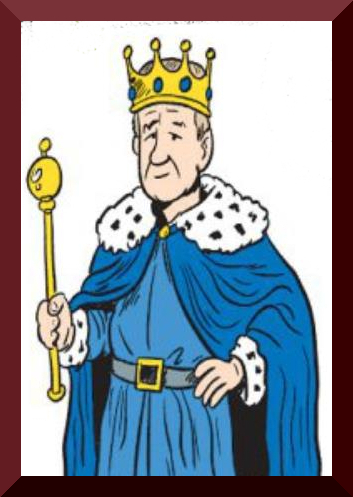
Anyway, in resigned recognition—but assuredly not acceptance—of Donald Trump’s reign as the United States of America’s first monarch—absolute or otherwise—since our forefathers declared independence from Britain, here’s a little number by John Bull called “The King’s Hunt.” It dramatizes Trump’s tireless pursuit, persecution, and prosecution of the good people who don’t kiss his fat ass or whom he resents or just doesn’t like:
Means and ways
30 October—The U.S. Senate remote video hearing on approving Donald Trump’s surgeon general has been postponed because Trump’s celebrity nominee, Dr. Casey Means, went into labor Thursday morning. Parturient labor, of course. God forbid any nominee of Trump’s should belong to the proletariat.
Trump wants Dr. Means to take over the surgeon general’s job—not a cabinet office, by the way—from acting surgeon general Denise Hinton, a nurse and scientist whom he appointed on the first day of his second term, when he found time between all the questionable executive orders he was excreting. She has retired, presumably of her own volition.
Trump must have known about Dr. Means being in the family way when he tapped her for a job for which she may be more qualified than many people are willing to admit. (Just because Trump wants her in the job doesn’t eo ipso mean she’s not qualified for it.) Of course, it didn’t hurt that Casey Means, like Trump, is a Bobby Kennedy Jr. admirer.
Nor did it hurt that Casey’s older brother, Calley, also is a Bobby Kennedy Jr. admirer. Evidently it was Calley’s admiration for Bobby Jr., which Trump shares with him, that got him to see the light and renounce his earlier (and clearly misguided) never Trumpism. Add to that Calley’s conservative and unregistered lobbyist credentials. Moreover, he’s a special government employee with the Department of Health and Human Services, which happens to be under the diabolically charlatanic thumb of Bobby Kennedy Jr.
On the off chance you’ve never heard of special government employees, an SGE is an alleged advisor or consultant who is appointed—supposedly for expertise and supposedly on a temporary basis—to work with the federal government, as defined in Title 18 of the United States Code. SGEs may be paid or do their special things as volunteers. Unless non-volunteer SGEs work is deemed essential, they’re not being paid during the shutdown.
Elon Musk and his thralls and collaborators in the dreaded Department of Government Efficiency were and many still are paid SGEs. DOGE is itself a temporary bureaucracy, scheduled to bite the dust on 4 July 2026. It’s actually the repurposed and rechristened United States Digital Service, which had been established by executive action—as opposed to executive order—by President Barack Obama in 2014 “to deliver better government services to the American people through technology and design.”
That allegedly remains part of DOGE’s remit in addition to the better known one of cutting costs, though you wouldn’t know it . . .
Lucky ICE
29 October—Among the lucky federal government employees who are actually being paid during the current Trumpublican-engendered shutdown are Immigration and Customs Enforcement deportation officers. That’s because Donald Trump’s deplorable One Big Beautiful Bill threw ICE an extra $75 billion. Xenophobia got Trump elected, after all. Equally deplorable Homeland Security Secretary Kristi Noem called the payments “super checks.”
So to show our appreciation of ICE, here’s a pair of pictures of Trump’s beloved unaccountable and otherwise privileged goons and thugs in action:

Trump is so cognitive
28 October—Below is an iteration of the Montreal Cognitive Assessment (MoCA) test administered to Donald Trump as part of his recent secondary physical. All the MoCAs are pretty much the same, differing from the one Trump aced in details like drawings to copy and animals to name.
Trump boasted, “I also did a cognitive exam, which is always very risky. . . . And one of the doctors said he’s almost never seen a perfect score. I had a perfect score. I had the highest score. [Of course.] And that made me feel good.” Sounds kind of like a child bragging to his mommy and daddy.
Should we believe Trump’s doctors any more than we believe anything else from or about Trump and his other flunkies?
Anyway, Trump naturally went on extol his own brilliance: “Those are really hard, they’re really aptitude tests, I guess, in a certain way. But they’re cognitive tests. The first couple of questions are easy. A tiger, an elephant, a giraffe, you know.” We won’t burden you with the insults he hurled at his critics in the process, quite as expected, but he brought up their low IQ. Of course.
Actually, the MoCAs are nothing like aptitude tests or IQ tests. Rather, as Trump acknowleged, they’re cognitive tests—screening tools—used to detect decline in functions like memory, attention, language, reasoning, and problem-solving. The maximum—perfect, per Trump—score on a MoCA is 30 and while there’s no pass or fail per se, 26 or higher is generally considered normal cognitive function.
Who’s to say that a lower score fails. Normal is merely a function of statistics, after all.
While the standard MoCA so heroically aced by Trump is specifically aimed at old farts, there are versions for other age groups. But, as you can see from the illustration, a normal child could do as well as Trump on the version to detect cognitive decline in senior citizens—a.k.a. senile dementia.
Incidentally, there’s no record of Joe Biden ever having taken a MoCA. That doesn’t mean he never took one, to be sure. Joe boasted that he had a “cognitive test every single day.” (But never volunteered how he did on it.) And his press secretary, Karine Jean-Pierre, who has since implicitly recanted in her memoir, told the world that Joe’s doctors determined that he didn’t need a MoCA because he “passes a cognitive test every day” by handling the rigors of the presidency. Sure.
Try it yourself. Nobody else will know . . .

It’s not all Hillary’s fault
27 October—Theodore Roosevelt, a Republican President of the United States back when the Republican Party was the good guys, was born on this day in 1858. He died at 60—probably of a pulmonary embolism—on 6 January 1919. His death was mourned 102 years later by a horde of Trumpublican goons and thugs invading the U.S. Capitol.
Yesterday was Hillary Clinton’s birthday. Apologies to her for our belated birthday wishes. Which birthday doesn’t matter. But Hillary is about 14 months younger than her husband and he’s a couple of months younger than Donald Trump. Hillary is credited—positively or negatively, depending upon one’s position on and/or feelings about Donald Trump—with getting him elected or allowing him to be elected to his first term as what in 2016 was the office of president.
Hillary didn’t make many friends on the right (but in the wrong) when she called (only?) “half” of Trump supporters “a basket of deplorables” in a 9 September campaign fundraising speech, remarking that they’re “racist, sexist, homophobic, xenophobic, and Islamophobic.” In all events, she shouldn’t have apologized the next day for stating the truth.
Moreover, even though her nomination was a back-room set-up, Hillary herself can’t seriously be blamed for Trump. Because, all things considered, she was only the tool—however cooperative and enthusiastic—of a complacent, inept, corrupt Democratic Party that simply couldn’t field a more electable candidate. Even if Bernie Sanders, Vermont’s socialist U.S. senator who filed as a Democrat for the occasion, hadn’t been screwed out of the nomination by the party establishment, a Democrat wouldn’t have been elected in 2016 to replace Barack Obama.
Donald Trump certainly had a lot going against him on all fronts. So it’s an incredible crying shame that he was able to wrest the Republican nomination from qualified, stable people like Chris Christie, John Kasich, and Jeb Bush, who likely could have defeated any Democrat who had expressed interest in the Oval Office.
The Democrats who had vied for the party’s presidential nomination in 2016 included Martin O’Malley, Lincoln Chafee, and James Webb, as well as ad hoc Democrat Bernie Sanders. They, like Hillary Clinton and unlike Donald Trump, were competent, qualified, and stable. And probably good people, even though politicians. But, you’re wondering, who were they? Forgotten already. And that’s precisely why Trump was able to finagle his way into the presidency in 2016.
Bernie Sanders, while pointing out the obvious, that Trump is a megalomanic and pathological liar, also owns that he’s a good politician. Actually Trump is a brilliant politician because he’s a brilliant demagogue and con man. And, sad to say, that’s precisely what getting elected and staying in office are all about . . .
